
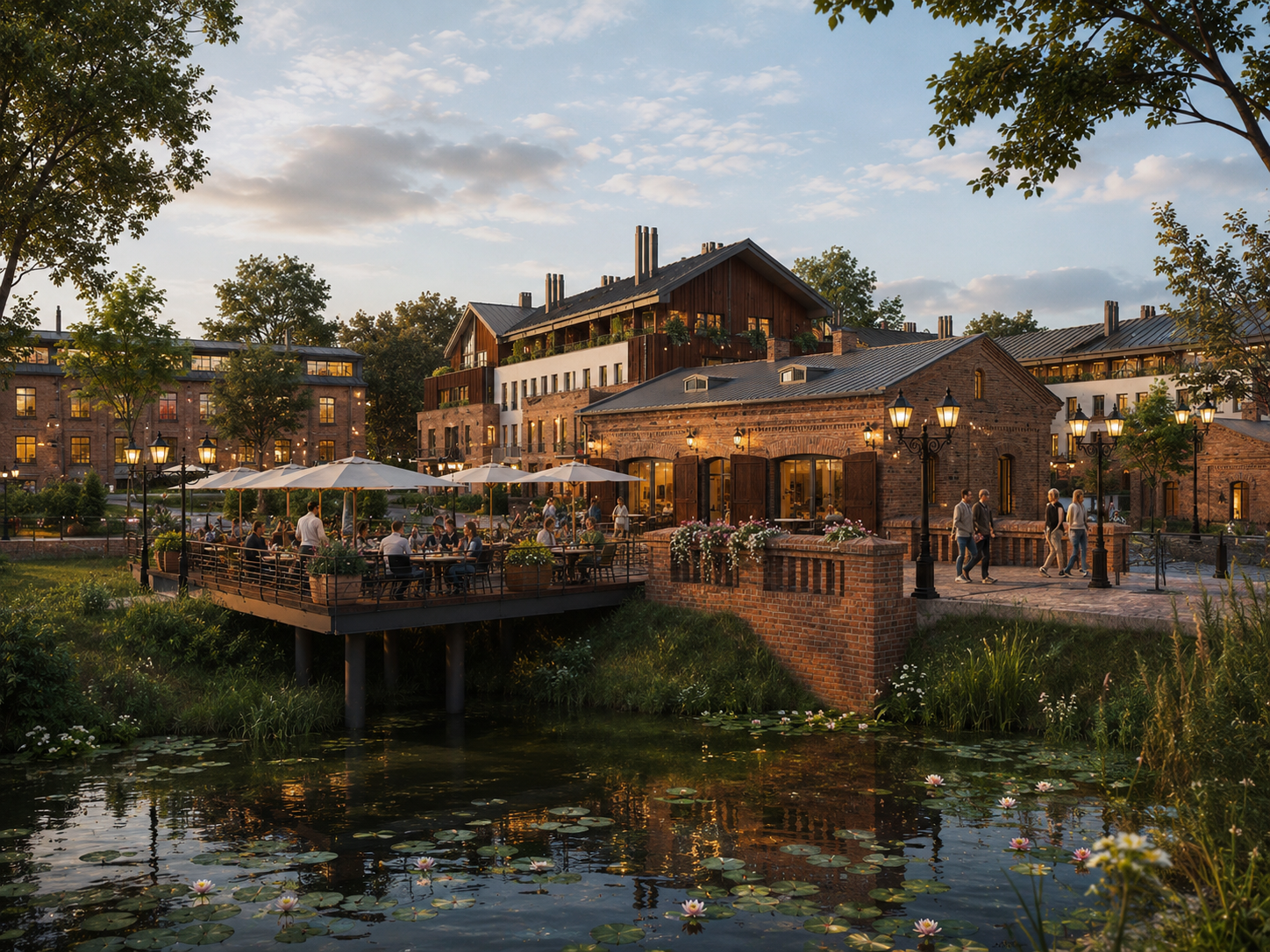
This project approved in 2008 is rooted in the rich industrial history of Łódź and the legacy of the Scheibler family, one of the city’s most influential families of industrialists. In the second half of the 19th century, Karol Scheibler created an industrial empire so extensive that his properties occupied approximately one-sixth of the city.
Along the Jasień River, the Scheibler family established an agricultural estate that included a farmstead with stables, a cowshed, and a granary. Over time, much of the surrounding land evolved into what is today Park Nad Jasieniem, while several historic structures survived as reminders of the site’s past.
The project focused on bringing these buildings back to life and integrating them into a new, intimate residential development. The historic structures were carefully renovated and adapted to contemporary uses, while new architecture was introduced in dialogue with the scale, materials, and industrial character of the original complex.
Because of the site's historic significance, the project was developed under heritage conservation supervision, requiring a careful balance between preservation and transformation. Original brick architecture and industrial details became an important part of the identity of the new development rather than simply remnants of its past.
Its location beside the pond and Park Nad Jasieniem creates another important layer of the project—the relationship between historic architecture, water, landscape, and contemporary urban life.
This project is also particularly personal to me. Łódź is the city where I was born, and a place to which I remain deeply connected. Having the opportunity to participate in the transformation of a piece of its architectural heritage made this project especially meaningful.